
Why Does It Matter?
If you’re buying or selling a home with a private well in Guilderland, NY, a well flow test is one of the most important inspections you can schedule. A well flow test measures how much water a well can produce over time and helps determine whether the water supply is reliable for daily household use.
In Upstate New York communities like Guilderland, Altamont, Voorheesville, New Scotland, Knox, and surrounding Albany County areas, many homes rely on private wells instead of municipal water systems. A home can appear to have normal water pressure during a quick showing, but that does not necessarily mean the well can sustain water demand throughout the day. That’s where professional well flow testing becomes critical.
This guide explains how well flow testing works in Guilderland, what inspectors look for, common problems discovered during testing, and why buyers should never skip it during a real estate transaction.
What Is a Well Flow Test?
A well flow test evaluates two primary things:
- The well’s flow rate
- The well’s recovery capability
The flow rate is typically measured in gallons per minute (GPM). This indicates how much water the well can produce continuously over a specified period.
The recovery capability measures how quickly the well replenishes itself after water is drawn down.
A properly functioning residential well should provide enough water for normal household activities such as:
- Showers
- Laundry
- Dishwashing
- Toilets
- Outdoor hose use
- Simultaneous appliance operation
In Guilderland and surrounding areas, lenders, homebuyers, and inspectors often consider a well producing at least 3–5 gallons per minute to be acceptable for most residential properties, although actual needs vary based on household size and water usage.
Why Well Flow Testing Matters in Guilderland, NY
Private wells in Albany County can vary significantly depending on:
- Local geology
- Well depth
- Aquifer conditions
- Seasonal groundwater levels
- Well age
- Pump condition
Two neighboring homes may have completely different well performance.
Some areas around Guilderland, Altamont, and western Albany County contain bedrock wells with lower production rates than homes connected to shallow groundwater sources. During dry summer months or periods of heavy demand, weaker wells may struggle to keep up.
Without testing, buyers may not discover issues until after closing, including:
- Low water pressure
- Running out of water
- Pump damage
- Sediment intrusion
- Slow recovery rates
- Intermittent water service
A professional well flow test helps identify these risks before purchase.
How a Well Flow Test Is Performed
Step 1: Inspecting the Well System
The inspector first evaluates the visible components of the well system, which may include:
- Pressure tank
- Pressure switch
- Wellhead condition
- Pump operation
- Plumbing connections
- Filtration equipment
The inspector also gathers available information about:
- Well depth
- Pump size
- Installation age
- Previous maintenance records
Visible deficiencies can sometimes indicate underlying performance problems.
Step 2: Measuring Static Water Level
Before heavy water use begins, the inspector may measure the static water level.
This is the distance from the ground surface to the standing water level inside the well before pumping starts.
The static level helps establish a baseline for determining:
- Available water reserve
- Drawdown during testing
- Recovery performance
Step 3: Running Water Continuously
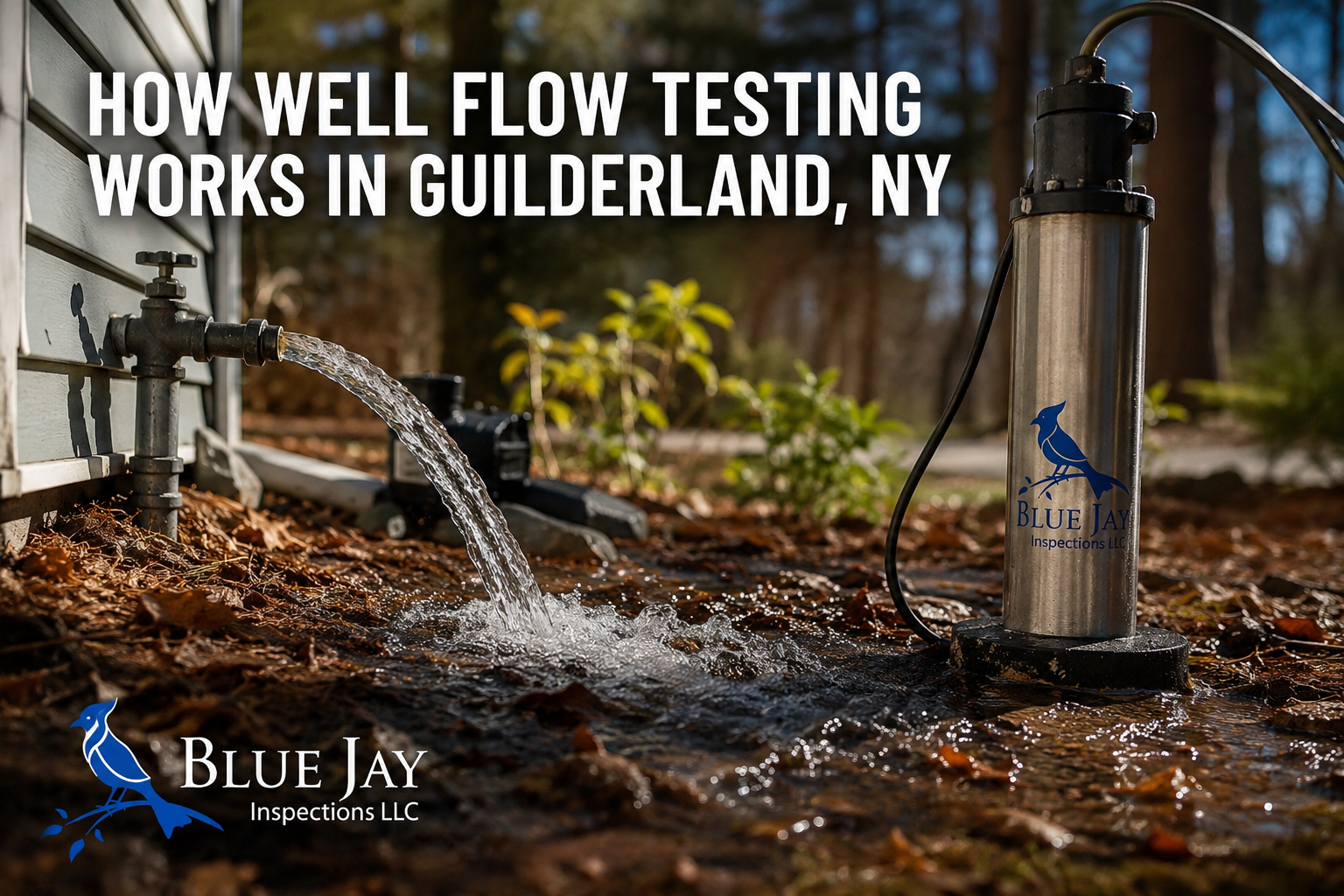
The actual flow test involves running water continuously from an exterior hose bib or designated discharge point.
During this process, the inspector measures:
- Gallons per minute output
- Pressure behavior
- Pump cycling
- Water consistency
- Recovery performance
The water is typically discharged away from the septic system and foundation to avoid flooding or overloading the drain field.
Step 4: Monitoring Drawdown
As water continues flowing, the inspector watches for excessive drawdown.
Drawdown occurs when the water level inside the well drops faster than the well can recover.
Problems may become apparent if:
- Pressure drops dramatically
- Water sputters or surges
- Air enters the plumbing system
- Flow rate declines over time
- The pump struggles to maintain output
A well that initially performs well but cannot sustain production may still be considered problematic.
Step 5: Evaluating Recovery
After the test period ends, the inspector may evaluate how quickly the well recovers.
A slow-recovering well can still create daily usage problems even if short-term flow appears adequate.
Recovery testing helps determine whether the well can support:
- Multiple showers
- Laundry cycles
- Peak morning water use
- Irrigation demands
- Larger households
How Long Does a Well Flow Test Take?
Most well flow tests in Guilderland take between:
- 1 to 3 hours for standard testing
- Longer for extended recovery evaluations
The exact duration depends on:
- Well performance
- Property setup
- Pump capacity
- Client requirements
- Lender standards
Some mortgage programs or buyers may request extended yield testing for additional confidence.
What Is Considered a Good Well Flow Rate?
There is no single universal standard, but general residential guidelines include:
| Flow Rate | Typical Assessment |
|---|---|
| Less than 1 GPM | Very low yield |
| 1–3 GPM | Marginal for many homes |
| 3–5 GPM | Often acceptable |
| 5+ GPM | Good residential supply |
| 10+ GPM | Excellent production |
However, total well performance depends on more than just GPM.
A low-yield well with strong storage capacity may still function adequately, while a higher-yield well with poor recovery could present issues.
Professional interpretation matters.
Common Problems Found During Well Flow Testing
Low Yield Wells
Some wells simply cannot sustain normal household demand.
This is especially concerning for larger homes with:
- Multiple bathrooms
- Large families
- High water usage
- Irrigation systems
Failing Well Pumps
Weak or aging pumps may struggle during extended operation.
Signs include:
- Pressure fluctuations
- Pump short cycling
- Inconsistent flow
- Pump overheating
Pressure Tank Problems
A failing pressure tank may cause:
- Rapid cycling
- Uneven pressure
- Reduced water delivery
- Premature pump wear
Sediment or Dirty Water
Heavy pumping can disturb sediment inside the well.
This may reveal:
- Cloudy water
- Sand intrusion
- Mineral buildup
- Filtration concerns
Seasonal Water Supply Issues
Some wells perform adequately during wet seasons but struggle during drought conditions.
Testing helps identify wells operating near their limits.
Should Buyers Always Get a Well Flow Test?
In most cases, yes.
A standard home inspection does not always fully evaluate well production capacity. A dedicated well flow test provides critical information about one of the home’s most important systems.
Skipping the test could leave buyers facing expensive repairs after closing, including:
- New well drilling
- Pump replacement
- Water storage systems
- Pressure tank replacement
- Filtration upgrades
Well-related repairs can easily cost thousands of dollars.
Can a Home Pass a Home Inspection but Still Have Well Problems?
Absolutely.
A home may appear fully functional during a short walkthrough because:
- Water use is minimal
- The pressure tank is temporarily masking low yield
- The well has not been stressed long enough
- Previous occupants used less water
A dedicated flow test places the system under sustained demand to reveal hidden problems.
Is Well Flow Testing Different From Water Quality Testing?
Yes. These are separate services.
Well Flow Testing Measures:
- Water quantity
- Production rate
- Pressure stability
- Recovery performance
Water Quality Testing Evaluates:
- Bacteria
- Nitrates
- Lead
- Arsenic
- pH levels
- Contaminants
- Mineral content
Many buyers in Guilderland choose to perform both tests during the inspection period.
When Should Well Flow Testing Be Scheduled?
The best time is during the home inspection contingency period.
This allows buyers time to:
- Review results
- Request repairs
- Negotiate credits
- Obtain specialist evaluations if needed
Testing early in the transaction helps avoid delays before closing.
Why Local Experience Matters in Guilderland
Well systems throughout Albany County can differ substantially based on local terrain and groundwater conditions.
Inspectors familiar with Guilderland, Altamont, Voorheesville, Bethlehem, New Scotland, Rotterdam, and surrounding Upstate NY communities understand:
- Regional well performance patterns
- Local groundwater concerns
- Common pump issues
- Seasonal water challenges
- Older rural well systems
This local experience helps provide more accurate evaluations and practical recommendations.
Schedule Well Flow Testing in Guilderland, NY
If you are buying or selling a home with a private well in Guilderland or nearby Capital Region communities, professional well flow testing can help identify hidden water supply issues before they become expensive surprises.
Blue Jay Inspections provides professional well flow testing along with comprehensive home inspections, septic inspections, sewer scope inspections, mold assessments, water quality testing, and additional services throughout Guilderland, Albany County, and surrounding Upstate New York communities.